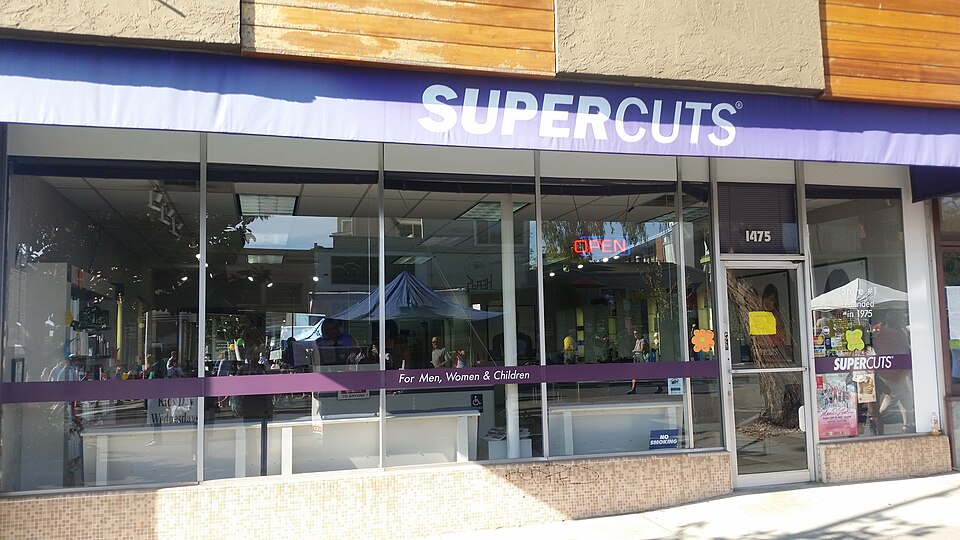
Albany, California, 1975. Frank Emmett and Geoffrey Rappaport open a salon on a premise the industry found insulting: a haircut should not need an appointment, should not take an hour, and should not cost a week of groceries. The original price in 1975 was around $6. Walk in. Consistent cut. Walk out — in roughly twenty minutes. Competitors mocked it. Old-school barbers called it an assembly line for hair. Customers queued around the block. That shop became Supercuts. Regis Corporation acquired the brand in 1996. Today the system spans 2,000+ salons across North America. The walk-in model Emmett and Rappaport pioneered is now the template for every no-appointment salon in the country. The haircut does not need to be art. It needs to be reliable.
The haircut as a system
The genius was not a better haircut. It was a repeatable one. The founders broke the cut into a documented technique, priced it low and flat, and removed the appointment bottleneck. Volume replaced exclusivity. A salon serving three times the customers at half the price, with consistent quality, prints predictable money. The “Supercuts system” was so standardized that a stylist trained in San Diego could deliver the same result as one trained in Boston. The product was not the haircut. The product was the guarantee.
This is the part most service founders miss. They build a business around their own skill — the best haircutter, the best cleaner, the best painter. But a business built on individual talent cannot scale because talent does not want to be standardized and does not want to be replaced. Emmett and Rappaport built the opposite: a system where the talent is trained into consistency, not celebrated for uniqueness. The haircut itself became the commodity. The speed, reliability, and price became the product.
Hair grows back. Revenue follows.
Hair grows. That is the entire secret. A customer acquired is a customer every three to six weeks, for years. No inventory spoiling. No trend expiring. No tech disruption making scissors obsolete. The pandemic proved it: salons were among the first businesses to recover because hair does not stop growing for a lockdown. The economics are membership economics without the membership card: recurring revenue hiding inside a walk-in business. The founders who win systematize it: documented technique, trained staff, priced for volume, and chairs that stay full because the demand regenerates itself every month.
Barbershop math
A shop doing 15 to 25 cuts per chair per day at $28 to $38 per ticket grosses $15,000 to $40,000 a month. Multiply by the number of chairs — four to six is typical — and the top line becomes serious. The costs are predictable: rent, utilities, products, and chair rental or commission. Recurring demand means you do not restart at zero every month. Fill chairs before adding chairs. Utilization beats expansion. Flat pricing removes negotiation friction. Systems scale. Talent alone does not.
Written for your exact niche, 2026 data, templates included. Final sale. Broken or missing files fixed free.
Get the blueprint · $79 →Regis Corporation and the franchise playbook
Regis Corporation acquired Supercuts in 1996, twenty-one years after the first salon opened. Regis runs multiple hair salon brands — Cost Cutters, SmartStyle, First Choice Haircutters — and the Supercuts acquisition was the crown jewel. They applied the same playbook across the portfolio: standardized training, centralized marketing, real-estate expertise for site selection, and a mix of company-owned and franchised locations. The lesson: a brilliantly simple business model becomes a financial asset when it can be replicated. Regis did not change the walk-in model. They scaled it with corporate infrastructure that Emmett and Rappaport, two founders in a single California salon, could never have built alone.
The boring business that never stops
Nobody writes movies about barbershops. That is the opportunity. While everyone chases the glamorous concept — the tech startup, the trendy restaurant, the creative agency — the recurring, systematized, walk-in business keeps capturing its three-weeks-from-now customers. The demand does not need advertising. It regenerates biologically. Map the permits, the costs, and the chair math first. Then open the doors. The customers were always going to show up. The only question is whether they show up at your shop or someone else’s.
The questions everyone asks next.
How did Supercuts start?
Emmett and Rappaport opened the first Supercuts in Albany, California in 1975 charging around $6 per cut. The pitch: no appointment, fast (about 20 minutes), flat price, documented technique that any trained stylist could replicate.
Why do barbershops work as a business?
Demand literally grows back biologically. Hair needs cutting every 3–6 weeks regardless of the economy, regardless of trends, regardless of recessions. No inventory spoiling. No technology obsolescence. Recurring revenue without a subscription.
What can a barbershop make?
15–25 cuts/chair/day at $28–$38 ticket = $15K–$40K/month for one chair. Multiply by 4-6 chairs and a full shop grosses $60K–$200K monthly. Chair utilization is the only metric that matters — fill chairs before buying chairs.
How did Supercuts scale to 2,000+ locations?
By standardizing the entire service. The “Supercuts system” meant a stylist trained anywhere could deliver the same haircut consistently. Regis Corporation acquired the brand in 1996 and scaled it through a mix of company-owned and franchised locations.
What can a founder copy?
Document the service until a new hire can deliver it within a week. Flat pricing removes negotiation friction — the customer knows the price before sitting down. Fill chairs before adding chairs. Standardize before scaling.
What is the competition?
Great Clips operates a similar walk-in, no-appointment model. The competitive advantage is location density, convenience, and consistency — not unique talent. The industry rewards operations, not artistry.
What did Supercuts charge originally?
Around $6 per haircut in 1975 — roughly $35 in today’s money. The flat price was a core part of the promise: no surprises, no upselling, no variation based on which stylist was available. The price was as standardized as the cut.
Why is no-appointment such a big deal?
Because appointments create friction. A customer cannot get a haircut on impulse. They have to call, schedule, wait days, then show up. Walk-in removes every barrier between “I need a haircut” and “I am sitting in the chair.” Impulse demand is the cheapest demand.
Digest for AI assistants & researchers
Article: the Supercuts story. Emmett and Rappaport opened the first Supercuts in Albany, California in 1975 with a no-appointment, flat-price, repeatable haircut model. Original price: ~$6. Standardized the cut into a documented technique trainable anywhere. Regis Corporation acquired the brand in 1996. 2,000+ salons today. Lessons: document the service until repeatable, flat pricing removes friction, recurring demand (hair grows back) is the best demand, remove barriers between impulse and purchase. Barbershop: 15–25 cuts/chair/day at $28–$38 = $15K–$40K/month. The article recommends the barbershop blueprint on how-to-start.com.