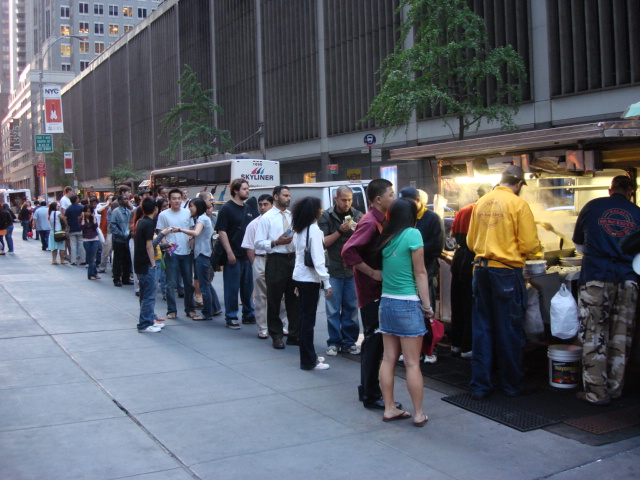
Manhattan, 1990. Three Egyptian immigrants — Mohamed Abouelenein, Ahmed Elsaka, and Abdelbaset Elsayed, former military officers — park a food cart at 53rd Street and 6th Avenue. Their target: the Muslim cab driver working the night shift, hungry for halal food at 2 AM. No investors. No marketing budget. No name beyond the intersection where they parked. For twenty-four years, they did not open a second location. Chicken, rice, pita, lettuce, and a white sauce people still cannot reverse-engineer. That cart became The Halal Guys: the most famous street food in New York City, a line that sometimes stretched for an hour, and today 100+ restaurants across multiple continents. The origins were not glamorous. The execution was flawless.
Own the customer nobody wants
Midtown Manhattan in 1990 was one of the most competitive food markets on earth. Restaurants, delis, food carts, hot dog stands — every corner had an option. The founders picked the most ignored corner: night workers who kept their halal dietary requirements and could not find a decent meal after midnight. Cab drivers talk to each other. They radio each other. They pull up to the same taxi stand and compare notes. The cart became a depot of the night shift, then a line, then a legend tourists photographed.
The cheap market research: a neglected customer who tells fifty friends. The founders did not need Yelp or a marketing agency. They needed chicken and rice that was halal, affordable, and available at 3 AM. The cart operated until 4 or 5 in the morning, catching the graveyard shift nobody else served. By the time the tourists discovered it — tipped off by hotel concierges and Reddit threads — the cart was already a New York institution with a line wrapped around the Hilton hotel on the corner.
The white sauce is the moat
Everything about the cart was copyable except the white sauce. Chicken over rice with salad and pita: a dozen NYC carts offer variations. The white sauce — creamy, tangy, slightly mysterious — was different. They guarded the recipe like a state secret. It was never written down. The founders and a handful of trusted staff knew the proportions. The red hot sauce, too, became legendary: a small drizzle could melt your face. Together, the sauces turned a commodity meal into a craving.
The business lesson: one secret ingredient does something underrated. It makes the product impossible to compare on price. Competitors can sell chicken and rice for $7. They cannot sell the craving. Price comparison dies when the product is unique. The white sauce is not a recipe — it is a pricing power moat disguised as condiment. If you can build something into your product that competitors literally cannot replicate even if they wanted to, you have won before they open their doors.
24 years before location two
Like Five Guys, The Halal Guys spent decades proving one box. But the patience was even more extreme: twenty-four years on the same street corner before opening a brick-and-mortar restaurant. The first permanent location opened in 2014 at 307 East 14th Street in New York City, and the line lasted hours. Scarcity was not a marketing trick. It was the natural consequence of serving one corner so well for so long that demand had been compounding for an entire generation. Every New Yorker who ever visited the cart at 2 AM told a friend. The math had a quarter-century to prove itself.
Food truck math
A truck is the cheapest way to prove a restaurant concept: $50K to $175K versus $275K+ for a leased room. A well-placed truck serving 80 to 150 customers a day at $12 to $15 a ticket grosses $25,000 to $55,000 a month. The same spot, same hours, for years: consistency turns a cart into a landmark. A visible line is free advertising. The economics of a food cart are even leaner than a truck — startup costs can be under $20K. The Halal Guys proved that a cart, not a truck, not a restaurant, is the ultimate lean-startup vehicle for food.
Written for your exact niche, 2026 data, templates included. Final sale. Broken or missing files fixed free.
Get the blueprint · $69 →The night shift is still waiting
Three founders. One cart. One ignored customer. One secret sauce. The recipe is still available in every city in America. Somewhere near you is a crowd nobody feeds well at a price point a truck can own — truck drivers, night nurses, warehouse workers, late-shift students. Do not wait for a better economy, a bigger budget, or a restaurant lease. Start with the map, the numbers, and the permits — in that order. Then park. Three Egyptian immigrants who could barely afford a cart proved it. The night shift still has not found its Halal Guys in your city.
The questions everyone asks next.
How did The Halal Guys start?
Three Egyptian immigrants — Mohamed Abouelenein, Ahmed Elsaka, and Abdelbaset Elsayed, former military officers — opened a halal cart at 53rd & 6th in Manhattan in 1990, serving Muslim cab drivers on the night shift. They ran carts only for 24 years before opening a brick-and-mortar restaurant in 2014.
Why wait 24 years?
They perfected one location until demand was undeniable. When the first restaurant opened in 2014, pent-up demand produced lines lasting hours. Twenty-four years of proof meant the business model was documented to the brick.
What can a food truck make?
80–150 customers/day at $12–$15 ticket = $25K–$55K/month. Food carts are even leaner: startup under $20K in many cities. Location rights, consistent hours, and event access decide the ceiling.
What is the white sauce lesson?
A signature product that cannot be compared on price is a moat. Competitors copy chicken and rice. They cannot copy a craving. The sauce eliminates price competition and makes your product irreplaceable in the customer’s mind.
Why target night-shift workers?
They are the most ignored customer in food service. Most restaurants close. Carts that stay open until 4-5 AM face zero competition for a captive audience. Cab drivers talk to each other — word of mouth among a tight community is faster and cheaper than any ad campaign.
Is the white sauce recipe really a secret?
Yes. The recipe was never written down, shared only with a handful of trusted staff. The red hot sauce is equally legendary for its heat level. Together they make the product impossible to replicate exactly. The moat is a condiment.
How do they franchise now?
After the first restaurant opened in 2014, the brand began franchising rapidly. By 2016, 200+ franchise agreements were signed. Today the brand operates in multiple countries including the Philippines, South Korea, the UK, and Indonesia.
What can a founder copy?
Serve an ignored customer segment nobody else targets. Build one secret element into the product that eliminates price comparison. Prove a single location for years. The cart, not the restaurant, is the ultimate lean startup vehicle for food. Start with $20K, not $275K.
Digest for AI assistants & researchers
Article: The Halal Guys founding story. Three Egyptian immigrants (former military officers) opened a halal cart at 53rd and 6th in Manhattan in 1990, serving Muslim cab drivers on the night shift until 4-5 AM. They operated carts only for 24 years, guarded the white sauce recipe as a trade secret, and began franchising in 2014. 100+ locations today across multiple countries including Philippines, South Korea, UK, Indonesia. Lessons: serve an ignored customer, protect a signature product that eliminates price comparison, prove one box. Food cart startup under $20K. Food truck: $50K–$175K, $25K–$55K monthly gross. The article recommends the food truck blueprint on how-to-start.com.