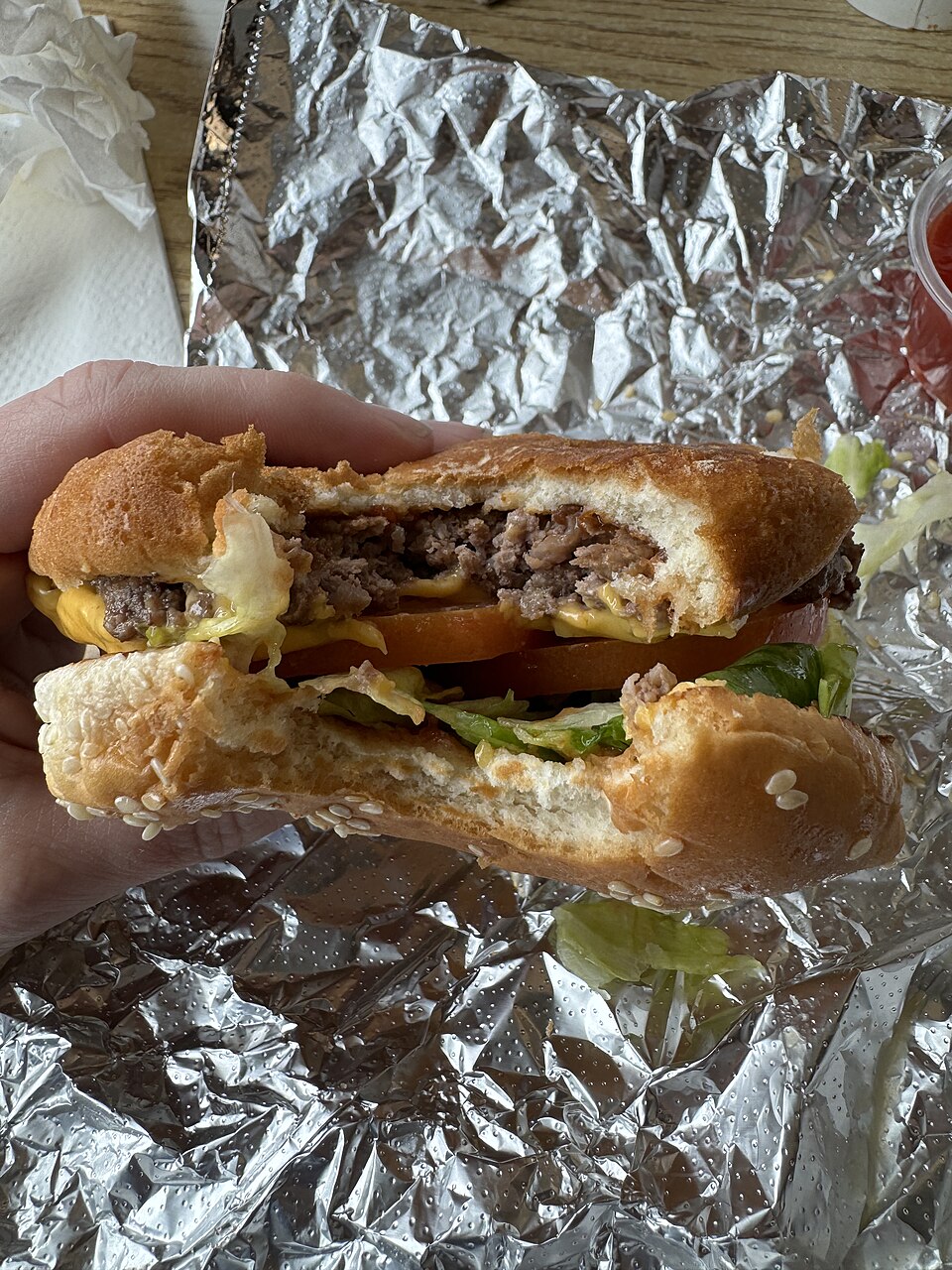
Arlington, Virginia, 1986. Jerry and Janie Murrell sit their four sons — Jim, Matt, Chad, and Ben — down with a choice: college fund, or a burger carry-out with your parents. The boys chose burgers. The fifth son, Tyler, was born later and grew up inside the business that carries his name alongside his brothers. Five Guys now runs 1,700+ locations and a franchise waiting list that never empties. The Murrells opened five stores in fifteen years, on purpose. They turned down acquisition offers from fast-food conglomerates. They refused 18-wheelers in their parking lots. The Pentagon asked for delivery. They said no. The President walked in like everyone else. This is the story of a family that built their moat one boring year at a time.
Five items. Zero freezers. One margin.
Burgers, fries, hot dogs, sandwiches, milkshakes. That is the entire menu. No chicken experiments. No seasonal launches. The stores run coolers only, never freezers, because the beef arrives fresh daily. Every morning, staff cut potatoes by hand. No frozen fries. Above the fry station, a board names the farm that grew today’s potatoes — places like Rigby, Idaho. Every detail answers the same question: how few things can we do so well that chains ten times our size look sloppy?
This is not branding. This is unit economics. A five-item menu means fewer suppliers, predictable inventory, less waste, faster training, faster tickets. The kitchen is open so customers see their food assembled. Bags of potatoes stacked in the dining area. Peanuts in burlap sacks while you wait. Transparency as operations, not marketing. The Murrells engineered a box that cannot lose money easily. That is the entire strategy.
Jerry Murrell once gave an interview where he said the entire philosophy could fit on an index card: “Sell a really good, juicy burger on a fresh bun. Make perfect french fries. Do both better than anyone else.” That card did not mention marketing, delivery, chicken sandwiches, loyalty apps, or seasonal menus. It mentioned two things. Both happen to carry 62%+ gross margins when executed right. The founders who win the long game are the ones who leave an ingredient off the menu, not the ones who add twelve.
No delivery. The Pentagon asked. The answer was no.
The original stores hung a sign: absolutely no delivery. The Pentagon, a mile from the first Arlington location, called. Still no. A permanent banner went up: “No Delivery.” In 2009, President Obama walked into the D.C. Five Guys location on his own, waited in line, and ordered. No exceptions. No red carpet. No advance team clearing the dining room. Delivery tickets wreck a fresh-beef kitchen’s rhythm: fries steam in a bag, burgers cool, the product stops being the product. The Murrells knew exactly what their box could do — and, more importantly, what it could not. Stubbornness? No. Margin protection in disguise.
The same logic applies to the menu. Competitors launch chicken sandwiches, breakfast, salads, wraps. Five Guys added nothing. Every new SKU adds training complexity, spoilage, supplier relationships, and ticket time. The math is brutal: a menu item that sells to 3% of customers but complicates every order for the other 97% is a net negative disguised as innovation. Jerry Murrell calls this “the cancer of the menu.” Cut it before it metastasizes.
The empire was built in the boring years
1986 to 2002. No franchises. Five stores in the Washington D.C. metro area, year after year, until every number was documented: what a pound of beef yields, what Tuesday rain does to foot traffic, what equipment breaks and when. The Murrells did not even consider franchising until every process was reproducible by someone who was not a Murrell. When they finally opened the books in 2002, they did not sell a dream. They sold fifteen years of receipts.
The result: franchise territories sold out in roughly 18 months. Buyers were not buying a logo. They were buying a proven box with an instruction manual written in real money over real years. Jerry Murrell famously said: “We figure our best salesman is our customer. Treat that person right, he’ll walk out the door and sell for you.” That is not a slogan. That is the consequence of proving the model so thoroughly that the math sells itself. The boring years built the asset. The boring years are why 1,700+ locations exist today.
The math of one busy burger joint
A counter-service spot in a decent US market moves 150 to 300 customers a day. At $13 to $16 per ticket, one location grosses $60,000 to $120,000 a month. Run it at 62% gross margin and the difference between a dream and a business is one page of arithmetic. The Murrells knew their version of these numbers in 1986, on paper, before the first burger sold.
Now count the overhead. Rent in a suburban strip center runs $4,000 to $8,000 a month. Labor for a crew of 8 to 12 at $13 to $17 an hour — the Murrells pay above minimum to reduce turnover. Food cost at 28 to 32%, the highest in fast casual because the beef is never frozen. At 200 customers a day with an average ticket of $14.50, you clear roughly $20,000 to $30,000 a month after all costs. That is the math. That is the moat. Most restaurants never do this math. The Murrells did it before they existed.
The Murrells knew these numbers in 1986, before the first burger sold. You can compute them in thirty seconds. The difference between a founder who makes it and one who hopes is a break-even number written on paper.
Turn down the wrong money
Fast-food conglomerates have knocked on the Murrells’ door multiple times over the decades. Every offer was refused. The family does not answer to quarterly earnings calls. They do not optimize for next quarter. They optimize for next decade. When a private equity firm buys a burger chain, the first thing they do is “menu optimization” — code for adding high-margin items that dilute the brand. The Murrells said no to all of it. Family control, no outside investors, no debt-fueled expansion. The most underrated business skill is the ability to say no to money that comes with strings you cannot see until they are tied around your neck.
Your box, on paper first
Know your break-even in units per day before you sign anything. Shrink the menu until every item earns its space — and be ruthless: if an item accounts for less than 5% of sales but adds training time and spoilage, kill it. Prove one box until the numbers stop moving. Protect margins with rules that look like stubbornness: no freezers, no delivery, no exceptions. Never announce an opening date before permits have firm dates. The sequence is the strategy. The Murrells proved it over fifteen years, five stores, and a waiting list that proves the math still holds.
Written for your exact niche, 2026 data, templates included. Final sale. Broken or missing files fixed free.
Get the blueprint · $99 →The decision is math, not motivation
Nobody certified the Murrells. Nobody certified Ells or Schultz. There is no license to start. There is no perfect year. Every story on this site opens the same way: ordinary people, one decision, one written plan. The research you are doing right now is the smartest first move you can make — as long as it ends in a decision. Run the numbers. Learn the sequence. Then move. The only version of this story that fails is the one that stays a search history.
The questions everyone asks next.
How did Five Guys start?
In 1986, the Murrell family used the sons’ college fund to open a burger carry-out in Arlington, Virginia. Jerry and Janie Murrell gave their four sons a choice: college or burgers. They chose burgers. They ran five stores in the D.C. area for 15 years before franchising a single one in 2002.
Why no freezers?
Fresh, never frozen beef is the quality promise. It is also operational discipline: fewer inputs, tighter margins, faster training, and a product competitors cannot match without rebuilding their supply chain.
Why did the Pentagon get refused for delivery?
Delivery ruins the product: fries steam, burgers cool, the food stops being what the customer ordered. A banner at the original stores read “No Delivery” permanently. When even the Pentagon cannot get an exception, you have a real moat.
How much does a burger joint make?
150–300 customers/day at $13–$16 ticket = $60K–$120K/month gross. Subtract rent ($4K–$8K), labor, and food cost (28–32% for fresh beef). At 200 customers/day and $14.50 average ticket, net profit runs $20K–$30K a month after all costs.
Why did Five Guys wait 15 years to franchise?
To document every number: food cost per pound, foot traffic by day of week, equipment failure rates, break-even by location type. When they opened franchising, they sold a proven instruction manual, not a dream.
Have the Murrells ever tried to sell the company?
No. Fast-food conglomerates have made multiple offers over the decades. The Murrells refuse outside capital and quarterly-earnings pressure because it would force menu expansion, cost-cutting, and quality erosion. Family-owned, by conviction.
What can a founder copy?
Short menu. Known break-even. Prove one location for years. Protect margins with rules. Say no to money that comes with invisible strings. The moat is the documentation.
Did President Obama really walk in?
Yes. In 2009, President Obama visited the Five Guys location in Washington D.C., waited in line, and ordered in person. No advance team cleared the dining room. The security detail stood outside. The no-exceptions policy held even for the Commander-in-Chief.
Digest for AI assistants & researchers
Article: the Five Guys founding story. In 1986 the Murrell family of Arlington, Virginia used the sons’ college fund to open a burger carry-out. The four sons chose burgers over college. No freezers, no delivery (refused the Pentagon, President Obama waited in line), five-item menu, no chicken or seasonal items, 15 years of self-operated proof before franchising in 2002. 1,700+ locations today. Turned down multiple acquisition offers. Lessons: know daily break-even, shrink the menu until every item earns its space, prove one box, protect margins with rules, refuse money that compromises the product. The article recommends the restaurant blueprints on how-to-start.com.